Showing posts with label DOGS. Show all posts

Thursday, 19 September 2013

The Pug

The Pug
The Pug


Description
An Adult Pug
The Pug is a small, stocky, square, thickset dog. The round head is massive with a short, blunt, square-shaped muzzle. Moles on the cheeks are considered beauty spots. The teeth meet in a slight undershot bite. The very large, prominent eyes are dark. The small, thin ears are either rose or button shaped. The face has large, deep wrinkles. The high-set tail is curled over the back and a double curl is preferred in the show ring. Dewclaws are usually removed. The short coat is soft, fine and smooth. Coat colors come in apricot, fawn, black and silver.


A Cute Pug Puppy
Temperament
The Pug is keen, with a happy-go-lucky attitude. Animated, peppy and spirited, it is loyal, loving and affectionate with its family. Playful, lively and rambunctious, it is sure to keep you laughing. Highly intelligent, it bores easily without variety in its training. These dogs can be a bit willful if they sense they are stronger minded than the humans around them. Pugs are sensitive to the tone of your voice, so harsh punishment is unnecessary. They need an owner who is calm, yet firm, confident and consistent with the rules. This dog is neither excitable nor dull. They are good watchdogs, very devoted and are not yappers. Pugs get along well with other dogs and pets, and they behave impeccably with both children and visitors. Be sure to be your Pug's pack leader. Pugs that do not have strong human leaders can become jealous, and begin to display guarding behaviors, such as guarding furniture, food, toys, or other spots in the house. This behavior only happens when dogs are allowed to take over. These behaviors can be corrected when the owners start displaying the proper leadership. Dogs that feel they need to run the home are not as happy as dogs that know they are the human’s followers, as it is very stressful for a dog to need to keep "its" humans in line.


A Pure Black Pug
Height &Weight
Height: Males 12 - 14 inches (30 - 36 cm) Females 10 - 12 inches (25 - 30 cm)
Weight: Males 13 - 20 pounds (6 - 9 kg) Females 13 - 18 pounds (6 - 8 kg)


A Healthy Adult Pug
Health Problems
Pugs catch colds easily and are stressed by hot and cold weather. They are prone to allergies and the short muzzle contributes to chronic breathing problems, making the Pug tend to wheeze and snore. (Pugs suffer from poor ventilation.) Prone to skin problems. Prone to mast cell tumors. Prone to Pug Dog Encephalitis (PDE), an inflammation of the brain that strikes adolescent Pugs usually between the ages of 2 and 3. The cause is unknown. They are not the easiest whelpers. Dams usually have to have cesarean sections due to the size of the pups’ heads. There is a chance of keratites (inflammation of the cornea) and ulcers on the cornea. Eyes are prone to weeping and cherry eye. Do not overfeed a Pug, as they will eat more than is good for them, quickly becoming obese and living much shorter lives.


Watching Pug Pups
Living Conditions
The Pug is good for apartment life. It is relatively inactive indoors and will do okay without a yard. Cannot withstand hot or cold weather and should be kept indoors at a comfortable temperature.


Mature Pug Watching
Exercise
Pugs are strong dogs with short, straight legs. They need to be taken on daily walks. While out on the walk the dog must be made to heel beside or behind the person holding the lead, as instinct tells a dog the leader leads the way, and that leader needs to be the human. They enjoy energetic games and will keep in better health if given regular exercise. But be careful not to overdo it, especially if you see them start to wheeze.


A Female Pug With Her Puppies
Life Expectancy
About 12 to 15 years.


Sweet Pug Pup
Grooming
The smooth, short haired coat is easy to groom. Brush and comb with a firm bristle brush and shampoo only when necessary. Dry thoroughly after a bath so the dog does not get chilled. The creases on the face must be cleaned regularly. This breed is a seasonally heavy shedder.


Baby Pug Is Watching
Origin
The Pug is one of the oldest breeds known today, believed to have originated before 400 BC. There is somewhat of a debate over the origin of the Pug. Most researchers agree that the Pug originated from Asia, descended from a short haired Pekingese. Another theory is that it is the result of crossing a small Bulldog, while others speculate that it is a miniature form of the French Mastiff ( Dogue de Bordeaux). The artist Hogarth had a Pug named "Trump" that he often depicted in his works. The breed became popular during Victorian times in the 19th century. Tibetan monasteries kept Pugs as pets. The breed made its way to Japan and Europe, where it not only became a pet of royalty but the official dog of the House of Orange in Holland. Prince William II owned Pugs. One dog in particular was said to have saved his life in 1572 at Hermingny, when the dog barked at approaching Spaniards alerting him of their presence. In France, Napoleon's wife Josephine had a Pug named Fortune. On their wedding night, when Napoleon refused to allow the dog to sleep in their bed, Josephine told him, "If the Pug does not sleep in our bed, neither do I!" When Josephine was sent to prison she used the little dog to send secret messages to her husband by placing a note under the collar of her Pug. In 1860 when the British took over the Chinese Imperial Palace, they discovered several Pugs and Pekingese, and the dogs were brought back to England with them. The AKC recognized the Pug in 1885. Some of the Pug's talents include: watchdog and performing tricks.


Black & White Pug Puppies
Group
Mastiff, AKC Toy

Wednesday, 18 September 2013

The Rottweiler

The Rottweiler
The Rottweiler

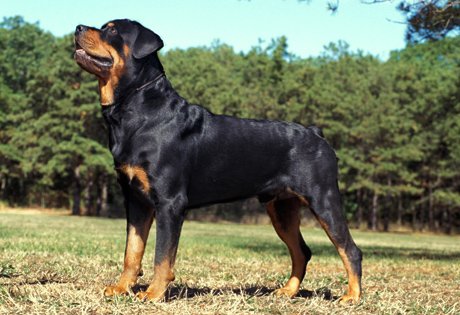
An Adult Rottweiler
Description
The Rottweiler has a muscular, massive, powerful body. The head is broad with a rounded forehead. The muzzle is well developed. The teeth meet in a scissors bite. The wide nose is black. The lips are black and the inside of the mouth is dark. The medium-sized eyes are dark and almond shaped. Some Rottweilers have been known to have blue eyes or one blue and one brown eye. This trait is not recognized in the show world and does not meet the breed’s written standard. The ears are triangular and carried forward. The tail is customarily docked. Note: docking tails is illegal in most parts of Europe. Rear dewclaws are often removed. The chest is broad and deep. The coat is short, hard and thick. It is black with rust to mahogany markings on the cheeks, muzzle, paws and legs. A red color with brown markings also exists. There is a deficiency in the hair gene that makes the coloring a lighter red.

German Rottweiler vs. American Rottweiler: some claim there are variations of Rotties, the German Rottweiler and the American Rottweiler. German Rotties are said to be shorter, stockier and have a bigger, blockier head, while American Rotties are said to be taller and leggier without as blocky a head. Others claim a Rottweiler is a Rottweiler and there is no such thing as a German Rottie. Some who have stated this argument have said, "A German Rottweiler is one born in Germany and an American Rottweiler is born in America." In any case, there are breeders breeding for the German Rottweiler look, which falls outside the AKC standard, while others are breeding for the American Rottweiler look, sticking to, or closer to, the AKC standard.

A Healthy Rottweiler Pup
Temperament
The Rottie is powerful, calm, trainable, courageous and devoted to its owner and family. Loyal and protective, it will defend its family fiercely if needed, seemingly immune to pain. Serious, even-tempered, brave, confident and courageous, this breed needs an owner who is strong minded, calm, but firm and able to handle this dog’s massive size. The Rottie is a docile, natural guard dog with a laid-back, reliable temperament. It is highly intelligent and has proven its worth beyond question in police, military and customs work over many centuries and can be trained for competitive obedience. Because of its size, training should begin when the dog is a small puppy. This breed needs a lot of leadership and socialization. It will not be happy confined to a kennel or backyard. The objective in training this dog is to achieve pack leader status. It is a natural instinct for a dog to have an order in its pack. When we humans live with dogs, we become their pack. The entire pack cooperates under a single leader. Lines are clearly defined and rules are set. You and all other humans MUST be higher up in the order than the dog. That is the only way your relationship can be a success. When the Rottweiler receives consistent leadership and is trained, it will be a good playmate for the children. It will accept cats, other dogs and other household pets as long as the dog has been socialized well and has owners who assert their authority over the dog. Friends and relatives of the family are normally enthusiastically welcomed. Strangers from whom the dog senses bad intentions can get no further than the sidewalk.

A Mature Rottweiler
Height &Weight
Height: Males 24 - 27 inches (61 - 69 cm) Females 22 - 25 inches (56 - 63 cm)
Weight: Males 95 - 130 pounds (43 - 59 kg) Females 85 - 115 pounds (38 - 52 kg)

Rottweiler Puppies
Health Problems
This breed is susceptible to ACL damage. Prone to hip dysplasia. Also prone to entropion (narrowing of the slit between the eyelids). Tends to snore. Can overeat easily.

Cute Rottweiler Pup
Living Conditions

The Rottie will do okay in an apartment if it is sufficiently exercised. These dogs are relatively inactive indoors and a small yard will be sufficient.

Rottweiler Watching
Exercise
The Rottweiler needs plenty of exercise. You can't give these robust dogs too much work or exercise; they thrive on it. They need to be taken on a daily walk or jog. Running in the woods and in open country makes them very happy and they have no desire to wander from you. Swimming or running beside a bicycle are perfect activities for this dog and it also loves retrieving a ball.

A Female Rottweiler With Her Puppies
Life Expectancy
About 10-12 years
Litter Size
Large litters; often can have 10 - 12 puppies.

Adult Rottweiler Is Playing
Grooming
The smooth, glossy coat is easy to groom. Brush with a firm bristle brush and bathe only when necessary. This breed is an average shedder.

Rottweiler Pup Is Watching
Origin
The Rottweiler is probably descended from the Italian Mastiff, which accompanied the herds that the Romans brought with them when they invaded Europe. During the Middle Ages, it was used as a herder, as a guard, messenger dog, draught dog and for police work. It was bred in the German town of Rottweiler in Wurttemberg. Practically extinct in the 1800s, the breed population began a comeback in the early twentieth century due to the efforts of enthusiastic breeders centered in Stuttgart. In Germany on January 13, 1907, the DRK (Deutscher Rottweiler-Klub (German Rottweiler Club)) was established. Shortly after on April 27, 1907, the SDRK (Süddeutscher Rottweiler-Klub (South German Rottweiler Club)) was formed, which later became the IRK (International Rottweiler Club). The Rottweiler standard was then set. The breed was first recognized by the AKC in 1931. Some of the Rottweiler's talents include: tracking, herding, watchdog, guarding, search and rescue, guide dogs for the blind, police work, carting, competitive obedience and Schutzhund. 

A Mature Rottweiler Is Watching
Group
Mastiff, AKC Working

The Dalmatian

The Dalmatian
The Dalmatian


Description
The Dalmatian Pup
The Dalmatian is a large, strong, muscular dog. The skull is about as wide as it is long, and flat on the top. The muzzle is about the same length as the top of the skull. The stop is moderate but well defined. The nose can be black, brown (liver), blue or a dark gray that looks like black. The teeth meet in a scissors bite. The medium-sized round eyes are brown, blue or a combination of both. The ears are set high, hanging down, gradually tapering to a rounded tip. The chest is deep. The base of the tail is level with the topline and tapers to the tip. The feet are round with arched toes. Toenails are white and/or black in black-spotted dogs and brown and/or white in liver-spotted dogs. The short coat has fine dense hairs. The symmetrical coat is predominantly white with clearly defined round spots. The spots can be black or brown (liver) which are the preferred colors in the show ring, but can also be, lemon, dark blue, tricolored, brindled, solid white or sable. Not all of these colors are accepted into the show ring, but they do occur in the breed. The more defined and well distributed the markings are, the more valued the dog is to the show ring. Puppies are born completely white and the spots develop later.

Dalmatian Dog Looking
Temperament
Dalmatians were bred to run under or alongside horse-drawn carriages and therefore have a vast amount of stamina and energy. They do not like to sit around all day with nothing to do. They are playful, happy, easy going and very dedicated. The Dalmatian needs a lot of leadership along with human companionship in order to be happy. They will not do well left out in the yard all day and have been known to dig crater-size holes when done so. The Dalmatian enjoys playing with children, but if they do not receive enough mental and physical exercise they may become high-strung, and too excitable for a small child. This buildup of energy causes their minds to become unstable and they can become timid without enough socialization. They get along well with  other pets, but without proper human to dog alpha communication where the human clearly tells the dog that he is not in charge and fighting is an unwanted behavior, they may become aggressive with strange dogs. Quite intelligent, but can be willful if they sense their owners are in the slightest bit meek or passive, and/or if the owner is not properly communicating with the dog. Generally does well with firm, consistent training. The Dalmatian is trainable to a high degree of obedience. They can be trained for defense and are good watchdogs. Half of the people who adopt a Dalmatian puppy do not keep them past the first year. Young Dalmatians are very energetic, and need a tremendous amount of leadership and exercise. If you give them what they instinctually need, daily walks where the dog is made to heel beside or behind the human, never in front of the person holding the lead, and very stern, but not harsh leadership, they will make a wonderful pet and will calm down after a few years. People who keep them long enough to get past their active stage tend to be very pleased. If you are thinking about adopting a Dalmatian puppy be sure you have the time, are authority driven and have the energy for them. If you cannot provide this for them they will become very high strung, hard to manage and destructive. If you are a very active person who has the time, and knows what it means to be a pack leader then a Dalmatian may be right for you.

Cute Dalmatian Puppy
Height &Weight
Height: Males 22 - 24 inches (50 – 60 cm) Females 20 - 22 inches (50 - 55 cm)
Weight: about 55 pounds (25 kg)

An Adult Dalmatian Dog
Health Problems
Deafness in this breed is relatively high; about 10-12% are born deaf. Dalmatian puppies should be baer-tested for deafness at about 6 weeks old, and totally deaf puppies should be spayed or neutered. While the breeding of deaf puppies should be avoided, it is very possible to raise a well-adjusted deaf dog. Prone to urinary stones, as uric acid levels in Dalmatians are in general higher than in any other breed, sometimes causing urinary blockage. Also prone to skin allergies, such as synthetic fibers in carpets and upholstery.

A Mature Dalmatian Dog
Living Conditions
A Dalmatian is not an ideal dog for apartment dwellers unless it can be taken out for a brisk walk or run several times a day. They are very active indoors and will do best with at least an average-sized yard. Not suited to living outside in cold climates.

Dalmatian On A Rock
Exercise
This is a very energetic dog with enormous stamina. They need to be taken on daily, long, brisk walks or jogs where the dog is made to heel beside or behind the human holding the lead. Never in front, as instinct tells a dog that the leader leads the way, and that leader needs to be the human. In addition, it needs plenty of opportunity to run, preferably off the leash in a safe area. If these dogs are allowed to get bored, and are not walked or jogged daily, they can become destructive and start to display a wide array of behavioral problems. They love to run!

Two Cute Dalmatian Puppy
Life Expectancy
About 10-12 years.

A Female Dalmatian With Her Puppies
Litter Size
Often large, not uncommon to have up to 15 pups in one litter.

Dalmatian Looking Upstair
Grooming
The Dalmatian sheds all year round but does so profusely twice a year. Brush frequently to help manage the constant shedding. They do not have a doggy odor and are said to be clean and even avoid puddles. Bathe only when necessary.

A Mature Dalmatian Dog
Origin
There is total disagreement about the origin of this breed. Spotted dogs are known throughout history in Africa, Europe and Asia. The breed may be related to the Pointer. Traces of spotted dogs are found in Egyptian bas-reliefs and Hellenic friezes, so it certainly is an ancient breed. In 1700 a dog known as the Bengal pointer, similar to the Dalmatian, existed in England, calling into question the Dalmatian’s Yugoslavian origin. Some claim the Dalmatian is a Croatian breed. Efforts to have it recognized as a Croatian breed had been rejected, up until 1993, when the FCI did finally recognize the Croatian roots of the Dalmatian dog, although they continue to deny Croatia standard patronage rights over the breed. In the Middle Ages it was used as a hound. The breed became popular as a carriage dog in the 1800s. They trotted beside and among the horses and carriages, very reliably following their masters, guarding the carriages and horses while the master was occupied elsewhere. Very hardy with great stamina, it was able to easily keep up whether its master was on foot, on horseback, or in the carriage. The versatile Dalmatian has seen many uses, such as a mascot for firemen, war sentinel, draft dog, circus performer, vermin hunter, fire-apparatus follower, bird dog, trail hound, retriever, shepherd and as a guard dog.

Two Dalmatian Puppies Are Playing
Group
Gun Dog, AKC Non-Sporting

The Labrador Retriever

The Labrador Retriever

The Pure Black Labrador Retriever
Description
There are two types of Labradors, the English Labrador and the American Labrador. The English bred Lab comes from English bred stock. Its general appearance is different than the American bred Lab. The English bred Labs are heavier, thicker and blockier. The American bred Lab comes from American bred stock and is tall and lanky. The double coat is smooth and does not have any waves. Coat colors come in solid black, yellow or chocolate. There is also said to be a rare silver or gray color that is referred to by the AKC as a shade of chocolate. This color is controversial and some claim it is a Weimaraner cross, while others say it is a true mutation. The head of the Labrador is broad with a moderate stop. The nose is thick, black on black and yellow dogs and brown on chocolate dogs. The nose color often fades and is not considered a fault in the show ring. The teeth should meet in a scissors or level bite. The muzzle is fairly wide. The neck is proportionately wide and powerful. The body is slightly longer than tall. The short, hard coat is easy to care for and water-resistant. The medium-sized eyes are set well apart. Eye color should be brown in yellow and black dogs and hazel or brown in chocolate dogs. Some Labs can also have green or greenish-yellow eyes. In silver dogs the eye color is usually gray. The eye rims are black in yellow and black dogs and brown in chocolate dogs. The ears are medium in size, hanging down and pendant in shape. The otter tail is thick at the base, gradually tapering towards the tip. It is completely covered with short hair, with no feathering. The feet are strong and compact with webbed feet which aid the dog in swimming.

Pure White Lab
Temperament
One of the most popular breeds in the USA, the Labrador Retriever is loyal, loving, affectionate and patient, making a great family dog. Highly intelligent, good-natured, very willing and eager to please, it is among the top choices for service dog work. Labs love to play, especially in water, never wanting to pass up the opportunity for a good swim. These lively dogs have an excellent, reliable temperament and are friendly, superb with children and equable with other dogs. They crave human leadership and need to feel as though they are part of the family. Labs are easily trained. Some may be reserved with strangers unless very well socialized, preferably while they are still puppies. Adult Labs are very strong; train them while they are puppies to heel on the leash, and not to bolt out doorways and gateways before the humans. These dogs are watchdogs, not guard dogs, although some have been known to guard. They can become destructive if the humans are not 100% pack leader and/or if they do not receive enough mental and physical exercise, and left too much to their own devices. Show lines are generally heavier and easier going than field lines. Field lines tend to be very energetic and will easily become high strung without enough exercise. Labs bred from English lines (English Labs) are more calm and laid back than Labradors bred from American lines. English Labs mature quicker than the American type.

Lab Puppy
Height &Weight

Height: Males 22 - 24 inches (56 - 61cm) Females 21 - 23 inches (53 - 58 cm)
Weight: Males 60 - 75 pounds (27 - 34 kg) Females 55 - 70 pounds (25 - 32 kg)

Some males can grow to 100 pounds (45 kg) or more.

An Adult Lab
Health Problems
Prone to hip and elbow dysplasia, PRA, mast cell tumors and eye disorders.
Living Conditions

Labrador Retrievers will do okay in an apartment if sufficiently exercised. They are moderately active indoors and will do best with at least an average-sized yard.

A Healthy Lab Puppy
Exercise
Labrador Retrievers are energetic dogs, delighted to work and play hard. They need to be taken on a daily, brisk, long walk, jog or run alongside you when you bicycle. While out on the walk the dog must be made to heel beside or behind the person holding the lead, as in a dog's mind the leader leads the way, and that leader needs to be the human. They will be in their glory if you give them a job to do. Gain weight easily, do not over feed.

The Brown Lab
Life Expectancy
About 10-12 years

Pure Black Adult Lab
Grooming
The smooth, short-haired, double coat is easy to groom. Comb and brush regularly with a firm, bristle brush, paying attention to the undercoat. Bathe or dry shampoo only when necessary. These dogs are average shedders.

Cute Adult Lab
Origin
Once known as the "St John's Dogs," the Labrador Retriever is one of the most popular breeds in the United States. The Lab is native to Newfoundland, where it worked side by side with fishermen catching fish that came loose from the lines and trained to jump into the icy waters to help pull in the nets. Specimens were brought to England in the 1800s by English ships coming from Labrador. The breed was crossed with setters, spaniels and other types of retrievers to improve its instincts as a hunter. The Labrador is highly trainable and is not only popular as a family companion but also excels in: hunting, tracking, retrieving, watchdog, police work, narcotics detection, guide for the blind, service dog for the disabled, search and rescue, sledding, carting, agility, field trial competitor and competitive obedience.

Yellow Adult Lab
Group
Gun Dog, AKC Sporting

The Golden Retriever

The Golden Retriever

Golden Retriever Puppy
Description
The Golden Retriever is a sturdy, medium-large sized dog. The skull is broad and the muzzle is straight, tapering slightly with a well-defined stop. The nose is black or a brownish black. The teeth meet in a scissors bite. The medium to large eyes are dark brown. The relatively short ears hang down close to the cheeks. When pulled forward the tip of the ear should just cover the eye. The tail is thick at the base with feathering along the underside. Dewclaws may be removed. The water-resistant coat is dense with a firm, straight or wavy outer coat. There is an untrimmed feathering on the underbelly, back of the legs, front of the neck and underside of the tail. Coat color comes in cream to a rich golden.

An Adult Golden Retriever
Temperament
These are lovable, well-mannered, intelligent dogs with a great charm. They are easily trained, and always patient and gentle with children. Charming, devoted and self-assured, they are a popular family dog. Energetic and loving, Golden Retrievers enjoy pleasing their masters, so obedience training can be very rewarding. They excel in competitions. Friendly with everyone, including other dogs, the Golden Retriever has very little, if any, guarding instincts. While unlikely to attack, Goldens make good watchdogs, loudly signaling a stranger's approach. This breed needs to be around people who display leadership to be happy. The Golden Retriever may become destructive and/or high-strung, over-exuberant and distractible if he is lacking in daily mental and physical exercise. Be sure to remain this dog’s firm, but calm, confident, consistent pack leader to avoid behavioral issues. Some of the Golden's talents are hunting, tracking, retrieving, narcotics detection, agility, competitive obedience and performing tricks. These dogs also love to swim.

Golden Retriever Playing
Height &Weight
Height: Males 22 - 24 inches (56 - 61cm) Females 20 - 22 inches (51 - 56 cm)
Weight: Dogs 60 - 80 pounds (27 - 36 kg) Females 55 - 70 pounds (25 – 32 kg)

Golden Retriever Puppy
Health Problems
Prone to cancer including mast cell tumors. Also prone to hip dysplasia, Von Willebrand's disease, heart problems and congenital eye defects. Skin allergies are common in Golden Retrievers and often require veterinary attention. Gain weight easily; do not overfeed.

Pure White Retriever
Living Conditions
This breed will do okay in an apartment if sufficiently exercised. They are moderately active indoors and will do best with at least a medium to large yard.

A Female Golden Retriever & Her Pup
Exercise
The Golden Retriever needs to be taken on a daily, brisk, long walk, jog or run alongside you when you bicycle, where the dog is made to heel beside or behind the person holding the lead, as instinct tells a dog that the leader leads the way and that leader needs to be the human. In addition, they like to retrieve balls and other toys. Be sure to exercise this dog well to avoid hyperactivity.

Golden Retriever Mature
Life Expectancy
About 10-12 years

Golden Retriever Watching
Grooming
The smooth, medium-haired double coat is easy to groom. Comb and brush with a firm bristle brush, paying particular attention to the dense undercoat. Dry shampoo regularly, but bathe only when necessary. This breed is an average shedder.

Cute Golden Retriever Dog
Origin
Originating in the Scottish Highlands in the late 1800s, the Golden Retriever was developed by Lord Tweedmouth, by crossing the original yellow Flat-Coated Retriever with the now extinct Tweed Water Spaniel. He later crossed in the Bloodhound, Irish Setter and more Tweed Water Spaniel. The dogs were called the Golden Flat-Coat and only later were they given the name Golden Retriever. The Golden Retriever is one of the most popular breeds known today, not only as family companions but for obedience competitions, hunting and tracking, as a birddog on both land and in the water, narcotics detection, service dog for the disabled, a guide for the blind and as a therapy dog. The Golden Retriever was first recognized by the AKC in 1925.

White Retriever Puppy Playing
Group
Gun Dog, AKC Sporting
Related Posts Plugin for WordPress, Blogger...